
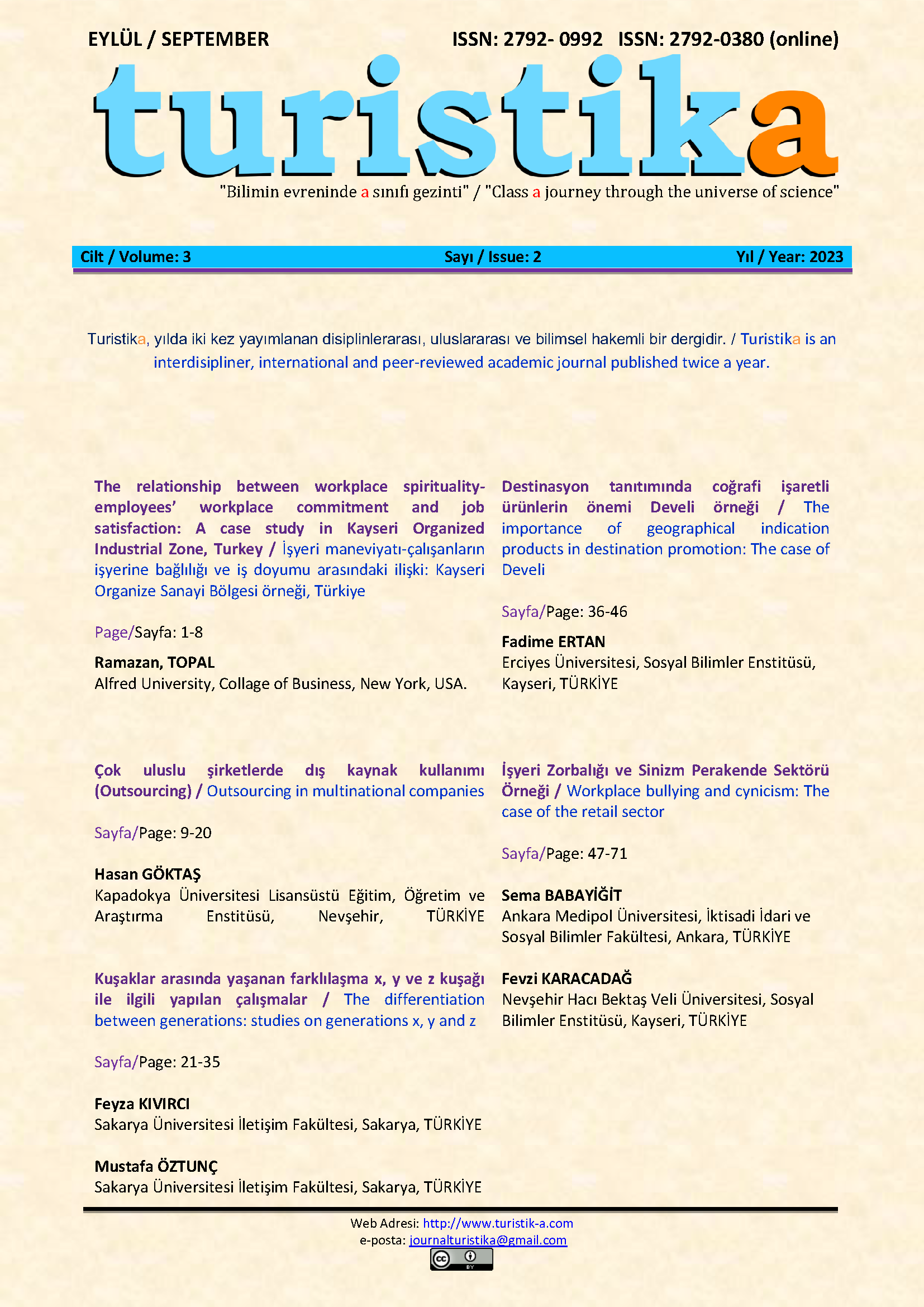
The importance of geographical indication products in destination promotion: The case of Develi
 Fadime Ertan
Published 30.09.2023
Keywords
- Geographical Indication,
- Destination Image,
- Develi
- Coğrafi İşaret,
- Destinasyon İmajı,
- Develi
How to Cite
Copyright (c) 2025 Fadime Ertan (Yazar)

This work is licensed under a Creative Commons Attribution-NonCommercial-NoDerivatives 4.0 International License.
How to Cite
Abstract
n today's travel and tourism industry, the creation of destination image, which has a significant impact on the perceptions of potential tourists in destination selection, holds great importance. In recent years, geographical indication products have become a notable factor in shaping destination image. Geographical indication products are valued by consumers due to their unique characteristics, quality, and reputation associated with a specific geographical region. Focusing on the potential of geographical indication products to contribute to the destination image is of paramount importance for Develi to more effectively leverage its tourism potential. This approach not only revitalizes the local economy but also enhances the region's capacity to attract more tourists. In this context, an analysis of studies related to Develi's tourism potential, destination image, and geographical indication products has been conducted to explore how Develi can contribute to the destination image through these distinctive products.
This research, based on qualitative research methods, aims to provide various recommendations for strengthening Develi's destination image, drawing insights from the data obtained.
References
- Akyurt, H., & Atay, L. (2009). Destinasyonda imaj oluşturma süreci. İşletme Araştırmaları Dergisi, 1(3), 35-56.
- Albayrak, M., & Ozdemir, M. (2012). The role of Geographical indication in brand making of Turkish handcrafts. International Journal of Business and Social Research (IJBSR), 2(3).
- Atasoy, B. Alternatif Turizm Kapsamında Sultan Sazlığı Ziyaretçilerinin Memnuniyet
- Düzeylerinin İncelenmesi. Iı. Uluslararası Develi-Âşık Seyrânî Ve Türk Kültürü Kongresi, 125.
- Baloglu, S. ve McCleary, K. W. (1999). A model of destination image formation. Annals of Tourism Research, 26(4): 868-897.
- Bulut, S. (2016). Hulled Wheat Farming in Develi. Current Trends in Natural Sciences Vol, 5(9), 115-119.
- Chaulagain, S., Wiitala, J., & Fu, X. (2019). The impact of country image and destination image on US tourists’ travel intention. Journal of Destination Marketing & Management, 12, 1-11
- Chu, Q., Bao, G., & Sun, J. (2022). Progress and Prospects of Destination Image Research in the Last Decade. Sustainability, 14(17), 10716.
- Crescenzi, R., De Filippis, F., Giua, M., & Vaquero- Pineiro, C. (2022). Geographical Indications and Local Development: The Strength of Territorial Embeddedness. Regional
- Studies, 56(3), 381-393.
- Creswell, J. W., & Poth, C. N. (2016). Qualitative inquiry and research design: Choosing among five approaches. Sage publications.
- Çukur, F., & Çukur, T. (2017). Coğrafi İşaretli
- Ürünlerin Kırsal Kalkınma Açısından Değerlendirilmesi: Muğla İli Örneği. Tarım Ekonomisi Dergisi, 23(2), 187-194.
- Dayısoylu, K. S., Yörükoğlu, T., & Ançel, T. (2017). Kahramanmaraş'ın Coğrafi İşaretli Ürünleri ve İlin Potansiyel Durumu. KSÜ Doğa Bilimleri Dergisi, 20(1), 80-88.
- Develi Belediyesi, (2023). https://www.develi.bel.tr
- Dogan, B., & Gokovali, U. (2012). Geographical İndications: The Aspects of Rural
- Development and Marketing Through The Traditional Products. Procedia-Social and Behavioral Sciences, 62, 761-765.
- Doğan, N., & Adanacıoğlu, H. (2022). Consumers’ Perception and Behavior towards
- Geographical Indication Products: The Case of Traditional Pestil from Gümüşhane,
- Turkey. Agrociencia.
- Doğu, A. F., Çiçek, İ., Gürgen, G.& Tunçel, H. (1999). Ayıini Mağarası Kayseri. Ankara Üniversitesi Dil ve Tarih-Coğrafya Fakültesi Dergisi, 39(1- 2), 335-345.
- Echtner, C. M., & Ritchie, J. B. (1993). The
- measurement of destination image: An empirical assessment. Journal of Travel Research, 31(4), 3-13.
- FAO. (2019). Geographical Indications (GI) for Sustainable Development: A Practical Guide for Developing Countries.
- http://www.fao.Org/3/CA3129EN/CA3129EN.
- Florentina, C. (2012). Protected Geographıcal Indıcatıon For Agrıcultural Products And Foodstuffs-Object of Intellectual Property Rıght. EkOHOMUka
- noftonpuBpede, 59 (C^e^ua.^bHblM Bbinyck),
- 293-299.
- Güllü, K. (2018). Bir Turizm Destinasyonu Olarak Develi'nin Turizm Potansiyelini Belirlemeye Yönelik Bir Swot Analizi. Business &
- Management Studies: An International Journal, 6(4), 862-877.
- Hosany, S., Ekinci, Y., & Uysal, M. (2006).
- Destination image and destination
- personality: An application of branding
- theories to tourism places. Journal of
- business research, 59(5), 638-642
- İlban, M. O. (2007). Destinasyon Pazarlamasında Marka İmajı ve Seyahat Acentalarında Bir Araştırma.
- Kantaroğlu, M., & Demirbaş, N. (2018). Türkiye’de Coğrafi İşaretli Gıda Ürünleri Üretim Potansiyelinin Değerlendirilmesi. IBANESS Kongreler Serisi, 21(22), 514-520.
- Kayseri Valiliği, (2023). http://www.kayseri.gov.tr
- Kesid, T., & Jakeljid, M. (2012). The Influence Of Determınıng Factors On Tourıstıc Destınatıon Image. Ekonomski pregled, 63(9-10), 486¬
- 517.
- Keskin, H. (2019). Coğrafi İşaretli Yöresel Gıdaların Turistik Destinasyon Pazarlamasına Etkileri- Balıkesir İli Örneği (Master's thesis, Balıkesir Üniversitesi Sosyal Bilimler Enstitüsü).
- Kotler, P. 1994. Marketing Management: Analysis, Planning, Implementation and Control (8 th ed.). Paramus, NJ: Prentice Hall International.
- Lee, R., & Lockshin, L. (2011). Halo effects of tourists’ destination image on domestic product perceptions. Australasian Marketing Journal, 19(1), 7-13.
- Mesıd, Z., Bozıd, M., & Cerjak, M. (2017). The İmpact of Geographical İndications on The Competitiveness of Traditional Agri-Food Products. Journal of Central European Agriculture, 18(1), 1-14.
- Nuary, R. B., Maksum, M., & Sukartiko, A. C. A Multidimensional Approach in Assessing Geographical Indication Product
- Sustainability: Salak Pondoh
- Sleman. Agritech: Jurnal Fakultas Teknologi Pertanian UGM, 42(1), 55-64.
- Pamukçu, H., Saraç, Ö., Aytuğar, S., & Sandıkçı, M. (2021). The Effects of Local Food and Local Products with Geographical İndication on The Development of Tourism
- Gastronomy. Sustainability, 13(12), 6692.
- Patton, M. Q. (2014). Qualitative research & evaluation methods: Integrating theory and practice. Sage publications.
- Pekyaman, A. (2008). Turistik Satın Alma Davranışında Destinasyon İmajının Rolü
- Afyonkarahisar Bölgesinde Bir Araştırma.
- İşletme Araştırmaları Dergisi, 18(1), 49-66.
- Qu, H., Kim, L. H., & Im, H. H. (2011). A model of destination branding: Integrating the
- concepts of the branding and destination image. Tourism management, 32(3), 465-476
- Serçek, G. Ö., & Serçek, S. (2017). X, Y ve Z Kuşaklarındaki Turistlerin Destinasyon İmaj Algılarının Karşılaştırılması. Seyahat ve Otel İşletmeciliği Dergisi, 14(1), 6-19.
- Strauss, A., & Corbin, J. (1990). Basics of qualitative research. Sage publications.
- Stylos, N., Vassiliadis, C. A., Bellou, V., &
- Andronikidis, A. (2016). Destination images, holistic images and personal normative beliefs: Predictors of intention to revisit a destination. Tourism management, 53, 40-60.
- Suh, J., & MacPherson, A. (2007). The impact of geographical indication on the revitalisation of a regional economy: a case study of ‘Boseong’green tea. Area, 39(4), 518-527.
- Şimşek, A., & Güleç, E. (2020). Gastronomi Turizmi Kapsamında Coğrafi İşaretli Ürün: Elazığ Orciği. Aydın Gastronomy, 4(2), 73-81.
- Toklu, İ. T., Ustaahmetoğlu, E., & Küçük, H. Ö. (2016). Tüketicilerin Coğrafi İşaretli Ürün Algısı ve Daha Fazla Fiyat Ödeme İsteği: Yapısal Eşitlik Modellemesi
- Yaklaşımı. Yönetim ve Ekonomi Dergisi, 23(1), 145-161.
- Tunçel, H. (1996). Develi İlçesinin Turizm Potansiyeli. Fırat Üniversitesi Sosyal Bilimler Dergisi, 8(1),341-360.
- Türk Patent ve Marka Kurumu, (2023). Coğrafi işaretler. Türk Patent ve Marka Kurumu Yayın Grubu.
- Ulama, Ş. (2015). Turizm Tanıtım Broşürlerinde Destinasyon İmajı Analizi: Türkiye
- Örneği. Bartın Üniversitesi İİ BF Dergisi, 6(11), 231-246.
- WIPO. (2021). Geographical Indications. https://www.wipo.int/geo indications/en/
- Yazıcı, H., & Şahin, S. H. (2013). CBS Yardımıyla Zamantı Çayı Havzası Ekoturizm
- Çekiciliklerinin Sunulması. Harita Teknolojileri Elektronik Dergisi, 5(3), 33-43.
- Yılmaz, Y. (2021). How Does Destination Image Evolve? Introducing the Co-creation of the Destination Image Approach. European Journal of Tourism, Hospitality and Recreation, 11(1), 11-21.
- Zhang, J., Wu, B., Morrison, A. M., Tseng, C., & Chen, Y. C. (2018). How country image affects tourists’ destination evaluations: A
- moderated mediation approach. Journal of Hospitality & Tourism Research, 42(6), 904¬93.