
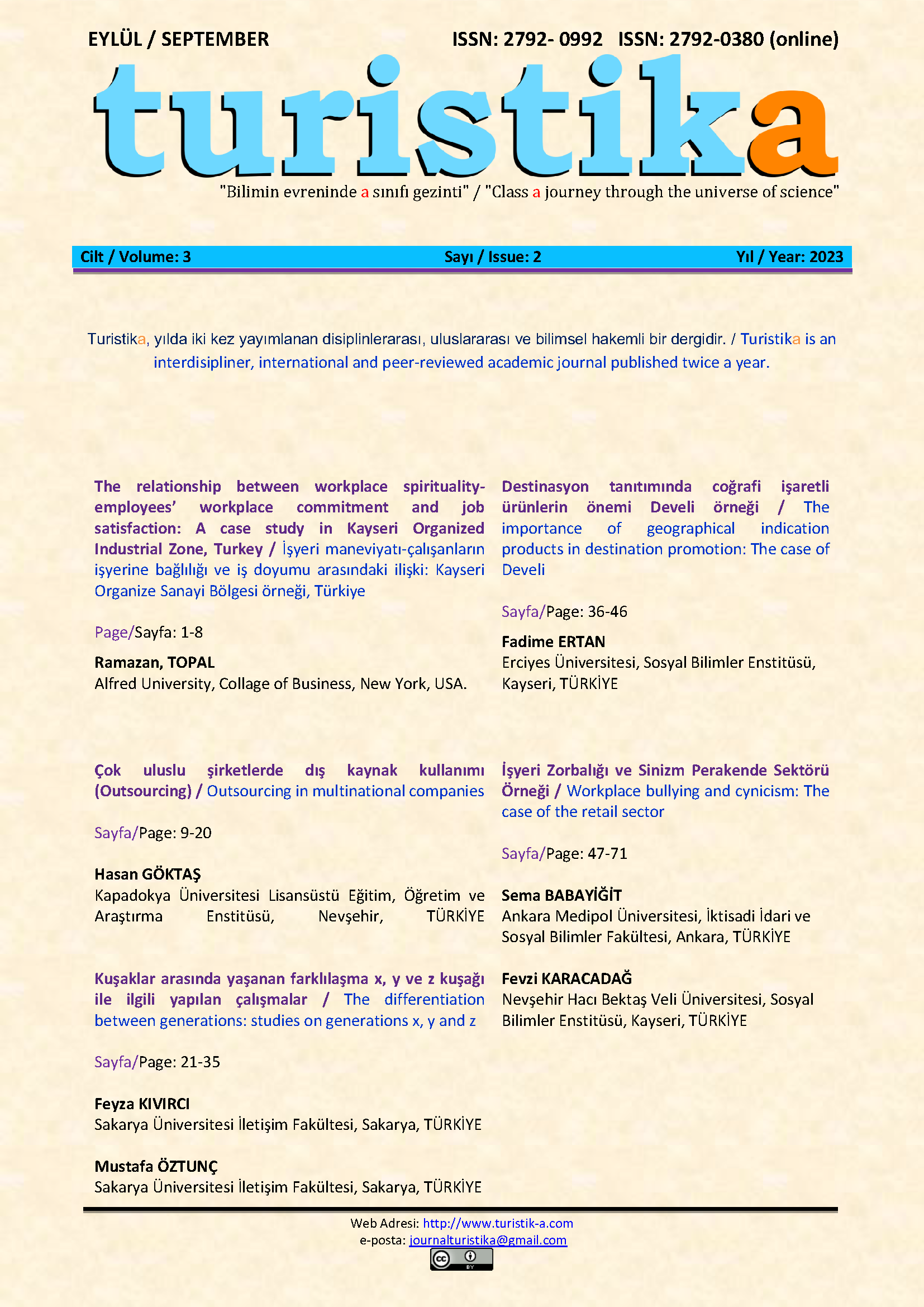
The relationship between workplace spirituality- employees’ workplace commitment and job satisfaction: A case study in Kayseri Organized Industrial Zone, Turkey
 Topal Ramazan
Published 30.09.2023
Keywords
- Workplace Spirituality,
- Workplace Commitment,
- Job Satisfaction
- İşyeri Maneviyatı,
- İşyeri Bağlılığı,
- İş Doyumu
How to Cite
Copyright (c) 2025 Topal Ramazan (Yazar)

This work is licensed under a Creative Commons Attribution-NonCommercial-NoDerivatives 4.0 International License.
How to Cite
Abstract
Workplace spirituality has gained increasing attention as a significant factor influencing employees' workplace commitment and job satisfaction. This abstract explores the intricate connection between workplace spirituality, employees' commitment to their organization, and overall job satisfaction. Workplace spirituality refers to integrating spiritual principles and values into the work environment, focusing on employees' holistic well-being and personal growth. By conducting a comprehensive literature review, this abstract highlights the importance of fostering a spiritually oriented workplace to enhance employee well-being and contribute to organizational success. The findings suggest that organizations embracing workplace spirituality witness higher levels of employee commitment and job satisfaction, leading to improved retention rates and overall performance. Furthermore, the abstract discusses the role of leadership in promoting workplace spirituality and offers practical strategies for its effective implementation in modern work settings. Emphasizing the positive outcomes associated with workplace spirituality, this abstract calls for organizations to recognize its potential and consider its incorporation a vital element of their organizational culture and practices.
References
- Ashmos, D. P., & Duchon, D. (2000). Spirituality at Work: A Conceptualization and Measure. Journal of Management Inquiry, 9(2), 134-145.
- Bell, C. M., & Taylor, E. W. (2018). Understanding workplace spirituality and its relationship with job satisfaction and well-being. Journal of Workplace Behavioral Health, 33(4), 297-312.
- Biberman, J., & Whitty, M. (1997). A postmodern spiritual future for management. Journal of Organizational Change Management, 10(3), 234-247.
- Bowling, N. A., Eschleman, K. J., & Wang, Q. (2010). A meta-analytic examination of the relationship between job satisfaction and subjective well-being. Journal of Occupational and Organizational
- Psychology, 83(4), 915-934.
- Cochran, D. S., & David, S. A. (2016). Organizational behavior and theory in healthcare: Leadership perspectives and management applications. Jones & Bartlett Learning.
- Csikszentmihalyi, M. (2003). Good business: Leadership, flow, and the making of meaning. Penguin.
- Davenport, T. H., & Prusak, L. (1997). Information ecology: Mastering the information and knowledge environment. Oxford University Press.
- Dhar, R. L. (2015). An exploratory study of spirituality in the workplace and its implications on job satisfaction. Journal of Business Ethics, 132(1), 191-198.
- Faragher, E. B., Cass, M., & Cooper, C. L. (2005). The relationship between job satisfaction and health: A meta-analysis. Occupational and Environmental Medicine, 62(2), 105-112.
- Fry, L. W. (2003). Toward a Theory of Spiritual Leadership. The Leadership Quarterly, 14(6), 693-727.
- Giacalone, R. A., & Jurkiewicz, C. L. (2003). Right from wrong: The influence of spirituality on perceptions of unethical business activities. Journal of Business Ethics, 46(1), 85-97.
- Griffin, R. W., & Moorhead, G. (2014).
- Organizational Behavior (11th ed.). Cengage Learning.
- Hackman, J. R., & Oldham, G. R. (1976). Motivation through the design of work: Test of a theory. Organizational Behavior and Human Performance, 16(2), 250-279.
- Harris, P. R., & Moran, R. T. (2017). Managing cultural differences: Global leadership strategies for the 21st century. Routledge.
- Hunsaker, P. L., Hunsaker, J. S., & Sweatt, W. C. (2017). A review of employee spirituality: Definition, measurement, and related variables. Journal of Management, Spirituality & Religion, 14(2), 116-147.
- Jain, A. K., & Sinha, A. K. (2015). Workplace
- spirituality, employee commitment, and job satisfaction in an emerging economy. Personnel Review, 44(5), 696-720.
- Jurkiewicz, C. L., & Giacalone, R. A. (2004). A values framework for measuring the impact of workplace spirituality on organizational performance. Journal of Business Ethics, 49(2), 129-142.
- Kinjerski, V., & Skrypnek, B. J. (2008). Four paths to spirit at work: Journeys of personal meaning, fulfillment, well-being, and transcendence through work. Career Development International, 13(3), 233-253.
- Kormanik, M. B., & Rocco, T. S. (2010). Expanding our understanding of workplace spirituality. Journal of Organizational Change Management, 23(3), 307-325.
- Luthans, F., & Youssef, C. M. (2004). Human, social, and now positive psychological capital management: Investing in people for
- competitive advantage. Organizational Dynamics, 33(2), 143-160.
- Milliman, J., Czaplewski, A. J., & Ferguson, J. (2003). Workplace spirituality and employee work attitudes: An exploratory empirical
- assessment. Journal of Organizational Change Management, 16(4), 426-447.
- Mitroff, I. I., & Denton, E. A. (1999). A study of spirituality in the workplace. Sloan Management Review, 40(4), 83-92.
- Morrison, E. W. (2003). Longitudinal study of the effects of information seeking on newcomer socialization. Journal of Applied Psychology, 88(1), 33-42.
- Nwosu, I. E., & Oranye, N. O. (2006). Linking spiritual values and organizational commitment in public sector service delivery in Nigeria. International Journal of Public Sector Management, 19(6), 504-520.
- O'Driscoll, M. P., Ilgen, D. R., & Hildreth, K. (1992). Time devoted to job and off-job activities, interrole conflict, and affective experiences. Journal of Applied Psychology, 77(3), 272¬279.
- Pang, S. M., & Hu, Y. (2019). Exploring the
- relationship between workplace spirituality, work engagement, and job satisfaction: Evidence from China. International Journal of Environmental Research and Public Health, 16(18), 3352.
- Podsakoff, P. M., MacKenzie, S. B., Moorman, R. H., & Fetter, R. (1990). Transformational leader behaviors and their effects on followers' trust in leader, satisfaction, and organizational citizenship behaviors. The Leadership Quarterly, 1(2), 107-142.
- Salanova, M., Agut, S., & Peiro, J. M. (2005). Linking organizational resources and work engagement to employee performance and customer loyalty: The mediation of service climate. Journal of Applied Psychology, 90(6), 1217-1227.
- Seidlitz, L., & Yager, J. (1992). The relationship of optimism, hope, and self-esteem to psychological well-being in older adults. Behaviour Research and Therapy, 30(5), 551-561.
- Steel, R. P., & Ovalle, N. K. (1984). A review and meta-analysis of research on the relationship between behavioral intentions and employee turnover.
- Thayer, P. W., Loscocco, K. A., & Stolte, O. E. (1991). Turnover as a response to unmet expectations: A comparison of voluntary and involuntary terminations. Journal of Applied Psychology, 76(5), 677-685.
- Thompson, C. A., & Prottas, D. J. (2005).
- Relationships among organizational family support, job autonomy, perceived control, and employee well-being. Journal of Occupational Health Psychology, 10(4), 100-118.
- Wright, T. A., & Bonett, D. G. (2007). Job satisfaction and psychological well-being as nonadditive predictors of workplace turnover. Journal of Management, 33(2), 141-160.
- Whitman, M. V., Van Rooy, D. L., & Viswesvaran, C. (2010). Satisfaction, citizenship behaviors, and performance in work units: A meta- analysis of collective construct relations. Personnel Psychology, 63(1), 41-81.
- Waddock, S. A. (2016). Leading corporate citizens: Vision, values, value added. Routledge.
- Warr, P., Cook, J., & Wall, T. (1979). Scales for the measurement of some work attitudes and aspects of psychological well-being. Journal of Occupational Psychology, 52(2), 129-148.
- Weiss, H. M., & Cropanzano, R. (1996). Affective events theory: A theoretical discussion of the structure, causes, and consequences of
- affective experiences at work. Research in Organizational Behavior, 18, 1-74.